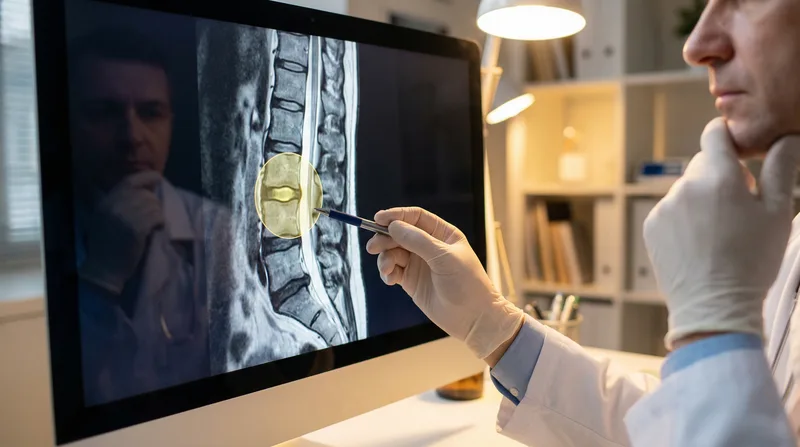
Fatal Blind Faith in Images
Why MRI and X-ray findings alone are not a surgical indication and how patients should interpret spinal imaging.
Imaging matters, but it is not the diagnosis. In spine care, patients are often told that an MRI “shows the problem”, as if the treatment decision were already made. That is too simplistic and often misleading.
What imaging studies actually show
A systematic review of asymptomatic people found that degenerative findings on spinal imaging become very common with age. In that review, the prevalence of disc degeneration increased from 37% in 20-year-olds to 96% in 80-year-olds. Disc bulges were also common, even in people without pain.
At the same time, a separate meta-analysis found that several MRI findings are more common in people with low back pain than in asymptomatic controls. That is important, but it still does not mean that every abnormal image is the pain generator. Imaging only becomes clinically useful when it is interpreted together with symptoms, physical examination and neurological findings.
Why this matters to patients
An MRI may show:
- age-related changes with little or no clinical relevance
- a finding that fits the symptoms well
- incidental abnormalities that look dramatic but are not the main cause of pain
This is why early or routine imaging can create confusion. NICE and Choosing Wisely both advise against routine imaging for acute low back pain without red flags. In many patients, early imaging does not improve outcomes and may shift attention toward incidental findings.
Imaging is most useful when it changes management
Imaging can be helpful when:
- there is progressive neurological deficit
- bladder or bowel dysfunction is suspected
- there is severe or persistent radicular pain
- fracture, infection, tumour or another serious cause is being considered
- a specialist assessment is planned and the result is likely to change treatment
The better question is not “Is the MRI abnormal?” but “Does the imaging fit the clinical picture, and would it change what happens next?”
Questions worth asking after an MRI
When a scan is being explained, these questions are often more useful than a long list of findings:
- Which part of this report actually matches my symptoms?
- Which findings may simply reflect normal ageing?
- Would the treatment plan be different without this scan?
- Are there neurological or examination findings that support the image result?
- Is surgery being suggested because of symptoms and deficit, or mainly because of how the scan looks?
When a second opinion makes sense
A second opinion is especially useful when:
- the scan sounds alarming but the clinical picture is unclear
- different surgeons suggest different procedures
- the explanation of the findings does not feel coherent
- a major operation is being proposed even though the symptoms are not clearly progressive
In degenerative spine problems, the match between imaging and symptoms is not always straightforward. A careful second review can reduce the risk of treatment based on the scan rather than the patient.
Red flags still matter more than image anxiety
Regardless of any MRI result, urgent medical assessment is important if there is new or worsening muscle weakness, saddle numbness, loss of bladder or bowel control, fever, or severe pain after trauma.
Bottom line
Images are a tool, not a verdict. Good spine care does not operate on MRI findings in isolation. It weighs the scan against symptoms, neurological status and the likely natural course of the condition. The larger the proposed intervention, the stronger that clinical match should be.
Further help
Further reading
- AJNR / PubMed: Systematic literature review of imaging features of spinal degeneration in asymptomatic populations
https://pubmed.ncbi.nlm.nih.gov/25430861/ - AJNR / PubMed: MRI Findings of Disc Degeneration are More Prevalent in Adults with Low Back Pain than in Asymptomatic Controls
https://pubmed.ncbi.nlm.nih.gov/26359154/ - NICE NG59: Low back pain and sciatica in over 16s
https://www.nice.org.uk/guidance/ng59 - AAFP Choosing Wisely: Imaging for Low Back Pain
https://www.aafp.org/family-physician/patient-care/clinical-recommendations/all-clinical-recommendations/cw-back-pain.html